
The Ahmedabad Crime Branch on Monday questioned Abdul Halim, an activist of the Students Islamic Movement of India, who was arrested in connection with the serial blasts, as it launched a massive operation to track down those involved.Halim was allegedly involved in recruiting people for Jehadi activities, the police said.The police also conducted raids in different parts of the city last night and detained many people for questioning.
The investigation into the serial blasts in Bengaluru has intensified with the police on Sunday questioning an unknown number of people as the needle of suspicion still pointed towards banned outfit Students Islamic Movement of India, with the crack team pursuing leads. The Bengaluru police are also in touch with their Ahmedabad counterparts following reports that the blasts there on Saturday were similar in nature to that took place in Bengaluru a day earlier.

The army on Sunday staged flag marches in communally-sensitive Ahmedabad where the death toll in the synchronised bomb blasts rose to 45 as several states went into high alert in the wake of terror strikes in Ahmedabad and IT hub Bengaluru.
Security forces have found that terrorists are difficult to interrogate and break. In the past four months, 15 key persons belonging to various outfits including the Students Islamic Movement of India were picked up from Karnataka and Indore. But getting information out of them has been difficult.
Intelligence Bureau sources said the recent regime change in Karnataka, with the Bharatiya Janata Party being elected to power, has made the banned outfit shift out of the state.

Police opened fire when the accused tried to escape after attacking escorts while being brought to Hyderabad for a court hearing.
Intelligence Bureau sources say a massive manhunt has been launched to track down these missing men. The agency is gathering telephone intercepts and other information, which includes statements made by those arrested in Madhya Pradesh.
An IB dossier on the organisation indicates that SIMI split in 2006. The IB says SIMI provides logistical support to the Laskhar-e-Tayiba and Harkat-ul-Jihadi.
The Karnataka police arrested an activist of the Student's Islamic Movement of India in Belgaum late on Wednesday night. The arrested person has been identified as Nasir Liyakat Patel. The police claim to have recovered hard disks and CDs, depicting bomb making techniques, from these activists The police are trying to find out whether Patel was planning to launch a terror attack in Karnataka.
After Saturday's bomb explosion damaging the court hall in Hubli, the Judicial First Class Magistrate Court, hearing the cases of terror suspects of banned SIMI, on Monday held its sitting in a different hall as two teams of investigators began the probe into the blast.
There has been a sudden crackdown on alleged activists of the Students Islamic Movement of India on the ground that they are planning on reviving the outfit. While this is one of the reasons that is being stated by security agencies the other reason is an alert sent by the Intelligence Bureau to all police stations in the country to keep a watch on the training programmes of the Lashkar-e-Tayiba.
Three persons, suspected to be Students Islamic Movement of India activists, were arrested from the New Housing Board colony in Morena, Madhya Pradesh.
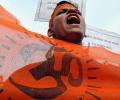
India's majoritarian regime is now making a dangerously fast-paced move towards theocracy, like its western counterpart did a few decades ago, warns Mohammad Sajjad.
Five activists of the banned Students Islamic Movement of India were arrested on Tuesday from Chanchoda town in Madhya Pradesh, police said.They were detained by the police on Monday from a hideout. However, four of their associates managed to escape from the spot.In Neemuch district, another suspected SIMI activist was arrested by the police.They were arrested on charge of indulging in unlawful activities and would be produced in court today for remand.
In a state of trance, Pandey reveals that while working for the Indian Air Force, he got in touch with Purohit who was in the military intelligence at that time.
Banned Students Islamic Movement of India chief Safdar Hussein Nagori on Monday admitted before police officials that a meeting of important leaders of the outfit took place at Ujjain just before the Mumbai train blasts, which claimed a large number of lives. However, Indore range Inspector General Anil Kumar told reporters that it is too early for the investigating team to establish whether the particular meeting took place to plot the Mumbai train blasts.
In yet another crackdown against the banned Students Islamic Movement of India, seven activists of the outfit were arrested by the Madhya Pradesh police in the last two days. Five activists of the outfit were arrested from Unhel town early on Monday. Two SIMI activists were arrested on Sunday evening on charges of providing assistance to its former chief Safdar Nagori and 12 other top activists, who were nabbed last week, in a major crackdown against the outfit.
Thirteen top leaders of the banned Student's Islamic Movement of India, who were arrested in Indore, had come to the city to finalise the training programme of its cadres, the police said on Friday. The leaders had been residing in Indore for over a month, a police official said, adding that the police have recovered news clippings from them relating to the Mumbai train blasts. The police was now trying to expose their local network.
The crackdown by Madhya Pradesh Police, along with central security agencies, began in and around Indore on Wednesday night and neighbouring Dhar district of the state during which top brass of the banned outfit was arrested. Among the prominent SIMI leaders arrested were Shibly Peedicaal Abdul, wanted in connection with Mumbai train serial blasts of July 2006, and former SIMI Chief Safdar Nagori and his brother Kamruddin Nagori, chief of the outfit's operations in AP.
With their arrest, the police had claimed to have solved six blasts cases including 2001 Sena Bhavan blast case.
Director General of Police, Karnataka, K Srinivasan on Thursday said that IT companies in Bengaluru should do a proper background check before recruiting people into their companies.
Abdul Razik Mansuri, a resident of Gomtipur area in the city, and an accused in the serial blasts was arrested on Thursday from Madhya Pradesh, Joint Commissioner of Police, crime branch, Ashish Bhatia told PTI. "He was arrested from the Nagda district in MP by our team. He was there staying with some of his relative. We have brought him to Ahmedabad for interrogation," he said.
The detention comes in the wake of the arrest of four suspected terrorists in Dakshina Kannada and Udupi districts last week in a joint effort by Mumbai and local police following the blasts in Bangalore and Ahmedabad.
The government on Thursday decided to continue the ban imposed on Students' Islamic Movement of India (SIMI) for its alleged links with certain Pakistan-based terrorist outfits.
According to the confessions made by Jaber, son of Moulana Nasirrudin, an accused in the Haren Pandya murder case, Safdar Nagori, the chief of the banned outfit had visited Hyderabad to zero down on a location to set up a terror training camp.
Conclusive evidence to link state-based SIMI activists with the Mumbai blasts is yet to be found, though a prankster was arrested on Wednesday for sending an e-mail to a newspaper office about the attacks.
'When fire has erupted all around your house, how can you have the luxury of a cool home? We have Pakistan and Bangladesh where 67 blasts took place in 2005. In Nepal they had huge insurgency, now Maoists have come to power. In Sri Lanka, what people called the most deadly terrorists outfit, the LTTE, is there'
SIMI does not believe in a nation-state. Its ultimate aim is to have an Islamic Caliphate with an Islamic India an integral part of such an arrangement. And to achieve this, SIMI sees secular, democratic modern India as a hurdle. Yet it is the secular cabal that acts as a cheerleader for SIMI!
Nagori, Abdul Sibley, Hafeez Hussain, Kamruddin Nagori and Amil Pervez were produced before Metropolitan Magistrate G M Patel who sent them to police custody till September 23.
Shabaaz, a 25-year-old suspected activist of the Students Islamic Movement of India, was arrested in Lucknow on Monday in connection with last month's serial blasts in Jaipur. Shabaaz was picked up by the Jaipur police from his computer institute in the busy Aminabad-Moulviganj area in Lucknow on Monday afternoon.
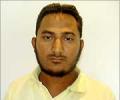
According to the Gujarat police, Muufi Abu Bashir was present in Ahmedabad on the day of the blasts. It is not yet known where he was from January 2007 to March 2008, when he allegedly took over as the head of the SIMI network after the arrest of Safdar Nagori, the general secretary of SIMI, and his brother Karimuddin by the Indore police in March this year
Their role was to hack into systems and send out mails prior and after terror attacks. This according to Nagori acted as a distraction to investigating agencies. Further they were also assigned the role of providing information relating to bomb making and the use of chemicals.

Police in Jammu and Kashmir and Telangana are investigating claims by three arrested youths from Hyderabad that they were planning to meet separatist leader Asiya Andrabi to join jihadi terror groups even as she dismissed as "fabricated" allegations that she had any links with Islamic State.

Asim Umar, Al Qaeda's Sharia council chief, heads its operations on the sub-continent.
The tribunal, while lifting the ban on SIMI, was at pains to make scathing remarks against senior Home Ministry officials as they appeared before it without any preparation about the case.
The Special Investigating Team probing the July 25 serial blasts in Bangalore picked up an activist of the Students Islamic Movement of India on Tuesday. With this arrest, the police say it is becoming clear that SIMI was behind the blasts in Bangalore and were using the name of Indian Mujahideen to conceal their identity.
However, now Intelligence Bureau sources tell rediff.com that terror modules were being set up in Belgaum, which borders Maharashtra. The arrest of Liyakat Ali Sayeed in Belgaum on May 14 has helped the police get a better picture of the terror operations, which were being planned in the border district of Karnataka.
Investigations being conducted into the failed Hubli bomb blast case has now revealed that the main accused, Nagraj Jambagi, wanted to target members of the Student's Islamic Movement of India who were to be produced before the court in Hubli.
Though Madhya Pradesh police are tight-lipped in this regard, all the indications are directed towards SIMI activists Abu Faisal, who was arrested from a hotel in the Gwaltoli area of the city in 2006 while attending a meeting of the banned organisation. He was release later on bail.
